

LGBT+ History Month 2026: Science & Innovation
To mark LGBT+ History Month 2026, we explore the theme of Science and Innovation by celebrating LGBT+ pioneers whose work transformed the way we live today. Read more to find out about the contributions of Barbara Burford, Charles Beyer and Jemma Redmond.
- Posted Fri, Feb 6, 2026 8:00 AM
The 2026 theme for LGBT+ History Month is Science and Innovation. This theme was chosen to highlight the vital contributions LGBT+ people have made historically and today.
Science and innovation are part of almost everything we do. From the technology we use at work and for travel, to advances in healthcare that save lives and improve outcomes for millions of people. Progress depends on curiosity and collaboration and so diverse teams are essential for innovation, yet many of us would struggle to name even a handful of LGBT+ scientists, engineers or researchers. For that reason, this year's theme shines a light on the LGBT+ people whose work underpins the systems we rely on so strongly, while also recognising how discrimination has often pushed their achievements out of mainstream history.
Below are just a few examples of LGBT+ individuals whose contributions to science and innovation continue to have a real and lasting impact.
Barbara Burford (1944-2010) - a medical researcher who established NHS equality and diversity guidelines
Barbara Burford was born in Jamaica in 1944 and moved to London with her family at the age of 9. She went on to study medicine at the University of London before specialising in electron microscopy within the NHS.
At the Institute of Child Health and Great Ormond Street Hospital, Burford and her team were involved in groundbreaking work on heart and lung transplant surgery for infants and children. Her scientific career was marked by a strong belief that medicine should serve everyone equitably, a belief which later shaped the focus of her work.
In the latter part of her career, Burford moved away from laboratory research to concentrate on equality and diversity within the NHS. She played a key role in developing equality guidelines adopted across the service which helped improve inclusivity at a national level. One outcome of this work was the introduction of multilingual touchscreen information points which can be found in most hospitals and GP surgeries. She also founded Job Shop, an in-house NHS employment agency designed to improve access to work. Later, Burford became a consultant and through her work in the Department of Health she contributed to equality guidance covering disability, gender and religion.
Alongside her professional achievements, Burford was a committed feminist and openly lesbian writer. She published plays, poetry and a novella, which were heavily inspired by her multicultural background and identity. Following her death in 2010, the University of Bradford established the Barbara Burford Memorial Lecture, which is now part of the annual Making Diversity Interventions conference, ensuring her legacy continues to inform equality work today.

For educational purposes only, from LGBT+ History Month 2026 (Schools Out)
Charles Beyer (1813-1876) - a locomotive engineer and a founding member of the Institute of Mechanical Engineers
Charles Beyer was born in Saxony, Germany, in 1813. His early education focused on architectural subjects such as drawing, mathematics and geometry, from which his technical skill was evident at a young age. After completing his studies, he received funding to travel to the UK, where he observed weaving machine technology in Manchester.
At just 21 years old, Beyer applied for a job in Manchester and was initially turned down. When offered a single sovereign coin as compensation, he refused because it was work that he wanted, not money. Impressed by his determination, the company took him on as a draughtsman working on cotton spinning machinery. He later moved into locomotive design. Within 10 years, Beyer became the company's chief designer and went on to co-found Beyer, Peacock & Co., one of the most important locomotive manufacturers of the 19th century. The company designed the condensing tank engines used on the newly established London Underground.
Beyer was also a founding member of the Institute of Mechanical Engineers, helping to professionalise engineering as a discipline. Although much of his personal life remains undocumented, historians widely acknowledge his lifelong partnership with Hermann Ludwig Lange, placing him within the history of gay men whose contributions were often quietly sidelined.
When Beyer died in 1876, he left a substantial portion of his wealth to what is now the University of Manchester. This funding was used to expand educational opportunities, particularly for working-class students, a legacy that continues to benefit generations of engineers and scientists.
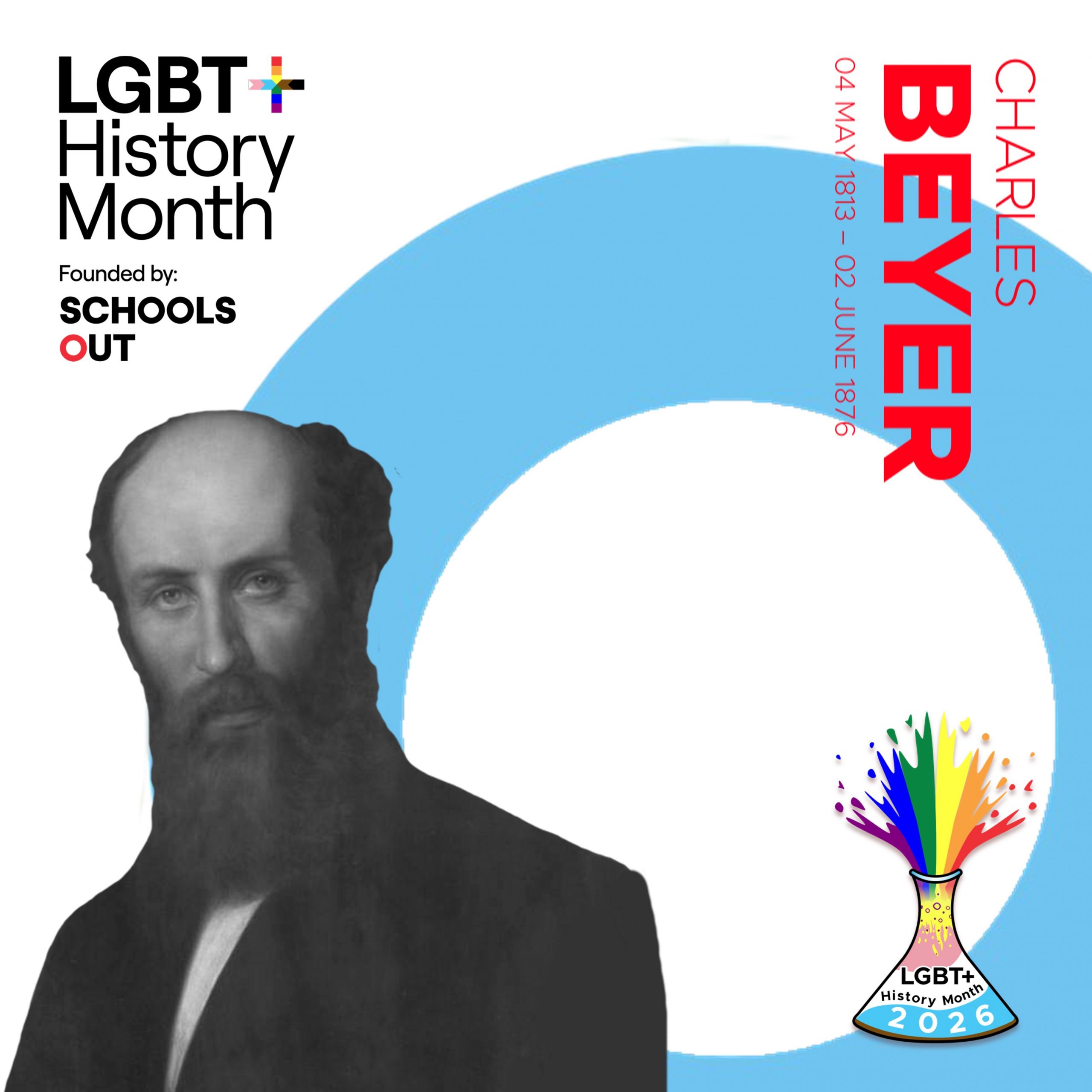 For educational purposes only, from LGBT+ History Month 2026 (Schools Out)
Jemma Redmond (1977-2016) - a biotechnologist who developed 3D bioprinters to create tissues and organs
Jemma Redmond was born in a working-class area of southwest Dublin. She completed a master’s degree in nanobioscience, alongside further qualifications in project management and electronic engineering. Her master’s thesis, completed with Professor Brian Rodríguez, focused on osteoblast adhesion on 3D printed scaffolds, an early step towards the development of functional bioprinted tissues. Redmond was open about being intersex, frequently speaking on social media about how her identity influenced her scientific ambitions. One of her long-term goals was to enable the printing of a fully functioning uterus.
Redmond went on to found the Irish 3D bioprinting startup Ouroworks (often referred to as Ourobotics), where she developed the world's first ten-material bioprinter capable of printing with live human cells. This breakthrough expanded what was possible in tissue and organ fabrication.
Before her death at the age of 38, Redmond designed and brought to market two major bioprinter models that significantly advanced the field while also reducing costs, making the technology more accessible to researchers. Today, several of her printers are used in clinical research at universities across Britain, supporting early-stage trials in bioprinted surgical components. While the field is still developing, these advances would not have been possible without Redmond’s foundational work.
 For educational purposes only, from LGBT+ History Month 2026 (Schools Out)
These individuals represent just a small fraction of LGBT+ people who have shaped science and innovation. Many faced discrimination, invisibility or disadvantage because of who they loved or how they identified. Yet they refused to be defined by those barriers. Instead, they challenged stereotypes and pushed boundaries that continued to benefit thousands, and in some cases millions, of people worldwide. Recognising their contributions is not just about celebrating the past, it's about ensuring that future generations of LGBT+ people can see themselves reflected in science and innovation.
Share Post
Post Tags
Latest Posts
Contact Us
-
Call: 023 9284 3628
-
Email: hello@upsu.net
-
-
Useful Links
Social Accounts

The University of Portsmouth Students’ Union has a vision of creating a positive impact with every Portsmouth student during their time at University.
